Where to Eat in Agadir in 2026 A Food Lovers Guide
Let me be upfront with you: Agadir has a lot of restaurants. A lot. Some of them are genuinely wonderful, and some are coasting on location alone. The gap between a meal you forget by tomorrow and one that changes how you think about Moroccan food is enormous. This guide exists to help you tell the difference before you sit down and order.
The tagine : the dish that separates the real from the fake
There is a very simple test to know whether a tagine is worth ordering: ask what time it started cooking. If they say "this morning" or "three hours ago," sit down. If the waiter hesitates, keep walking.
The real tagine in Agadir has nothing in common with what you find in Moroccan restaurants in London or New York. Here, in the best restaurant in Agadir, they cook over charcoal, not gas. The clay pot is not decorative. It is part of the recipe. It spreads a low, even heat that turns a tough piece of lamb into something that dissolves on your tongue.
The most Soussi version, and the most surprising for newcomers to Amazigh cuisine, is the tagine with prunes and almonds. The honey comes from the region, harvested from argan tree fields between Taroudant and Tiznit. The prunes swell gently in the sauce. The toasted almonds add crunch. The whole thing creates a sweet-salty balance that catches you off guard at first bite, then becomes impossible to resist.
You also find fresh fish tagine along the corniche, made with the morning catch. Chermoula, tomatoes, peppers, a drizzle of argan oil. It is Agadir in a dish. The kind of meal you eat facing the ocean, sand almost under your feet, and you do not forget it anytime soon.
My advice: beware of tagines that arrive in five minutes. A good tagine takes time. That is exactly why it is good. At La Table Amazigh, tagines cook over charcoal for hours in handmade clay pots, exactly the way Amazigh grandmothers have done it for generations.
The couscous : the dish nobody refuses
In Morocco, refusing couscous is almost an insult. On Fridays, it is sacred. Families gather, neighbors invite themselves over, and the smell of steaming semolina fills every street in Agadir from 10 in the morning.
What makes Souss couscous different is the work that goes into the semolina. In many places, they use precooked semolina, the kind that puffs up in five minutes. Here, in the real traditional restaurants of Agadir, women still roll the grains by hand, one by one, a repetitive and almost hypnotic gesture that demands extraordinary patience. The result is immediate on the first bite: the grains are light, separate, almost weightless. They absorb the broth without turning mushy.
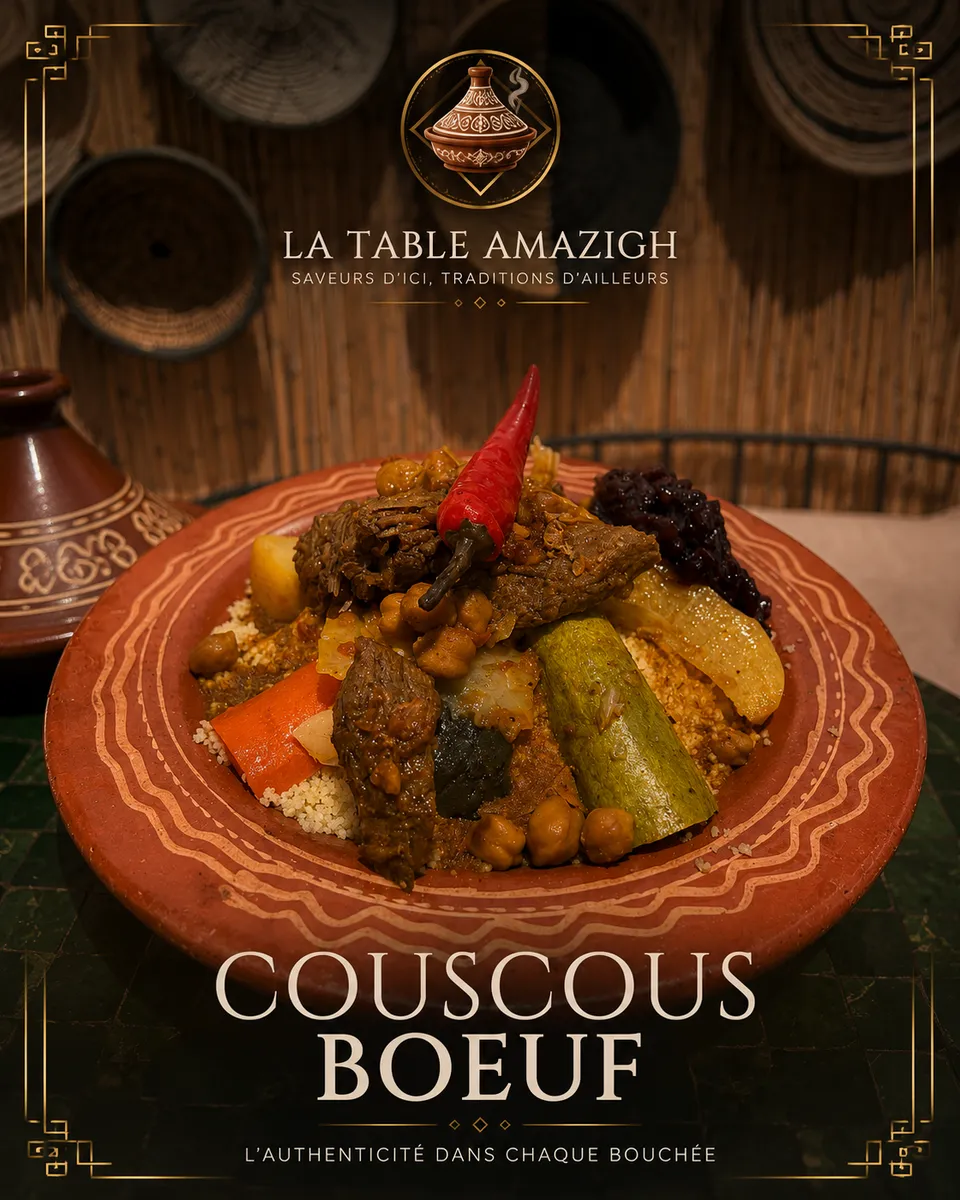
Royal couscous is the full version: seven seasonal vegetables, turnips, carrots, zucchini, pumpkin, cabbage, chickpeas, tomatoes, topped with pieces of lamb and chicken. The broth, perfumed with ras el hanout and saffron from Taliouine, is served separately in a small tureen. Everyone pours as much as they want. It is a generous, family-style meal that is not meant to be eaten alone.
There is also couscous tfaya, less well known but devastating: caramelized onions with honey and raisins piled on top of the semolina. The kind of dish nobody talks about enough, and that you regret not ordering sooner.
My advice: order your couscous on a Friday. It is not superstition. It is just that everyone is making couscous that day, and when every kitchen in town is cooking the same dish at the same time, the overall quality goes up a notch.
The pastilla : the dish that impresses every single time
Pastilla is probably the most sophisticated dish in all of Moroccan cuisine. It is the one reserved for weddings, baptisms, and grand celebrations. But in Agadir, some restaurants, like La Table Amazigh, serve it every day, and that is a blessing.
Picture this: layers of brick pastry, thin as paper, filled with a mixture of shredded meat, scrambled eggs with spices, toasted almonds, and cinnamon. The whole thing is baked until the surface turns golden and crispy, then dusted with powdered sugar and cinnamon.
Your first reaction will be "powdered sugar on meat? That is strange." And then you taste it. And you understand why this dish has existed for centuries. The crunch of the pastry, the sweetness of the almonds, the salt of the meat, the warmth of the cinnamon. All of it in one bite.
In Agadir, you also find seafood pastilla, a more recent version that plays on the city's proximity to the fishing port. Shrimp, calamari, vermicelli, creamy sauce. Less traditional, but just as successful.
My advice: pastilla must be eaten hot, straight from the oven. If it has been sitting, the pastry softens and loses all its magic. Always ask when it came out.
The mechoui : lamb that falls apart in your hands
Mechoui is the ultimate celebration dish in Morocco. A whole lamb, seasoned with cumin, salt, and smen, a fermented butter that Soussi families sometimes age for months, then cooked for four to six hours in a traditional clay oven.
The result is spectacular: the meat is so tender it pulls apart with your bare hands. No knife needed. The skin is crispy, golden, almost caramelized. The inside stays juicy and fragrant. You tear off a piece, dip it in a small pile of cumin and salt, and eat with your fingers. No cutlery, no pretension. It is raw, generous, communal. That is how we eat in Morocco.
The problem with mechoui is that not everyone can make it. You need a proper traditional oven, time, and a cook who knows what they are doing. Many restaurants in Agadir sell "mechoui" that is actually just lamb roasted in a regular oven. You can tell the difference from the first bite: real mechoui has that smen and smoke flavor that nothing can replicate.
My advice: book in advance. Mechoui starts cooking in the early morning for the evening service. If you show up without a reservation, it will be gone.
The harira : the soup that warms your soul before your stomach
Harira is the simplest dish on this list, and yet it is the one Moroccans talk about with the most affection. It is the soup of Ramadan, the one that breaks the fast every evening, the one whose smell alone can fill an entire house.
Tomatoes, lentils, chickpeas, celery, parsley, coriander, a little meat, and that flour liaison that gives the soup its velvety, almost silky texture. Every family has their recipe, every neighborhood has their version, and everyone is convinced that theirs is the best. I have heard arguments about harira more passionate than arguments about football.
In Agadir, harira is served year-round, not just during Ramadan. You find it in the small popular restaurants in the city center, served with dates and chebakia, those honey pastries shaped like flowers. It is a complete meal for a few dirhams.
What sets Souss harira apart is the generous use of fresh coriander and the local ras el hanout. Some add a squeeze of lemon juice right before serving. Others swear you need a drizzle of olive oil. The debate never ends, and that is precisely what proves this dish matters to people.
My advice: tasting harira in a tourist restaurant is like drinking tea at Starbucks. It goes down, but it is not the same thing. Look for the small hole-in-the-wall places where locals eat in the evening. That is where the real harira hides.
So where do you start?
If you only have one meal in Agadir, order a charcoal tagine. If you have three days, add the Friday couscous and the pastilla. If you have a week, try all five. And if you find a restaurant that nails all five dishes under one roof with fresh, local ingredients, keep that address. It is rare, and it is worth every dirham.
La Table Amazigh, in the heart of Agadir, is one of those places. Book online at latableamazigh.com, free delivery across Agadir.